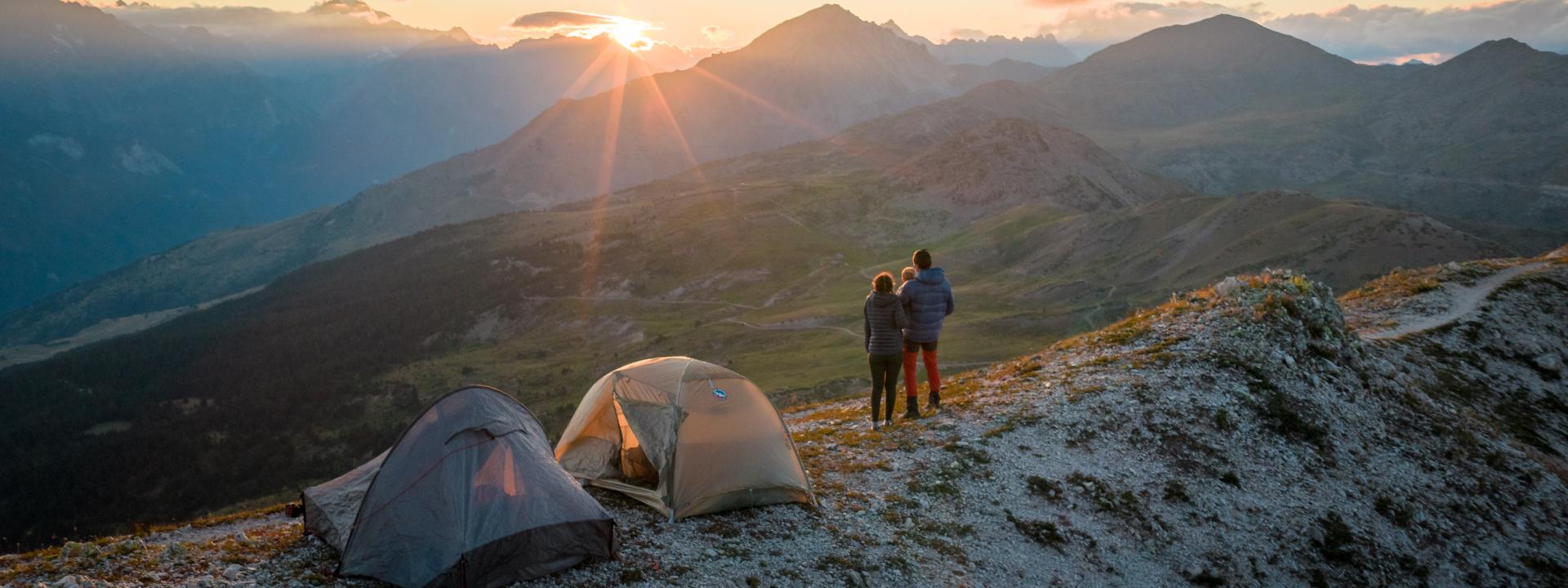
Sleep facing the mountains... without leaving a trace.
Bivouacs in the mountains are the stuff of dreams. And it's easy to see why. In the Écrins massif, the experience has that little taste of raw adventure that turns a simple hike into an unclassifiable souvenir.
But behind the postcards, there's a reality: natural areas are fragile. Very fragile.
Between 2021 and 2025, bivouac activity in the Ecrins National Park will double. The result: more visitors, but also more impact on fauna, flora and landscapes.
So how can you enjoy this magical experience while respecting nature?
Camping
means setting out with a lightweight tent to spend a single night in the great outdoors (but that’s not all)!
Here you’ll find all the rules to follow for bivouacking in an environmentally responsible way.
Bivouacking vs. wild camping: be careful—they’re not the same thing ⛺
This is probably THE most common source of confusion.
Bivouacking
Bivouacking involves spending a single night in the great outdoors in a small, lightweight tent, usually while hiking.
In the heart of Écrins National Park, it’s permitted under certain conditions.
Wild camping
Wild camping involves staying in the same spot for several nights or using heavier gear.
And here… the rules change significantly. Wild camping is very often prohibited or strictly regulated in protected natural areas.
For example, a tent pitched at sunset and taken down at sunrise does not have the same impact as a long-term setup resembling a “mini high-altitude village.”
Where can you camp in Écrins National Park?
Regulations are changing (June 2026)
Camping is prohibited within the park
Otherwise, camping is permitted only:
- between 7 p.m. and 9 a.m.
- more than an hour’s walk from a road access point or the park boundary
- in a lightweight tent where you cannot stand upright
Some areas have specific rules. Check before you go.
The Golden Rules of Responsible Camping 🏕️🌿
1. Arrive late, leave early
Camping should be done discreetly. Set up your tent in the evening. Take it down early in the morning.
2. Zero waste. Truly zero.
Peelings, tissues, packaging, food scraps… take everything back down with you. Even if it’s biodegradable, some waste disrupts ecosystems and attracts animals.
The rule is simple: If it goes in your pack, it comes back out in your pack.
3. Fires? No.
In Écrins National Park, fires are prohibited. Not even a small fire “for ambiance.” Not even “just a few branches.” Not even “because it was chilly.” In the mountains, a fire can have catastrophic consequences.
For cooking: use a camping stove.
4. Respect the silence of the mountains
A Bluetooth speaker by a high-altitude lake?
Let’s just say that’s not exactly the traditional song of the marmot. Responsible camping also means preserving the tranquility of the surroundings and respecting other hikers.
5. Observe the animals… without disturbing them
This is their home.
Never feed wild animals.
Keep your distance.
And carefully store food and trash to avoid attracting wildlife near campsites.
6. Stay on the trails
Cutting across switchbacks or creating makeshift trails weakens the soil and accelerates erosion. In the mountains, even a few repeated passages can sometimes be enough to permanently destroy alpine vegetation.
Can you camp with a dog?
In the heart of Écrins National Park, dogs are prohibited, even if kept on a leash.
Why?
Because their presence disturbs not only wildlife but also the herds grazing in the alpine pastures.
As a result of the new regulations, certain specific provisions of the ordinance
camping is prohibited:
- In particularly fragile sites within the core zone, marked as such on the ground (wildlife quiet zones, sensitive wetlands, lake shores, and others).
- On roads, parking lots, and heliport areas (drop zones) located within the core zone.
- The director may now establish quotas to preserve natural habitats and ensure the tranquility of wildlife. No quotas will be enforced in the summer of 2026.
- On the shores of Lakes Lauvitel and Muzelle, camping is prohibited within 500 meters of the lakeshore, except in designated camping areas marked by signage at these sites.
- The use of a portable gas stove is permitted while camping. Any other combustion device or open fire is prohibited.
- Wastewater from dishwashing, personal hygiene, or laundry must be discharged at least 50 meters from lakes, waterways, and wetlands.